
4 minute read • published in partnership with Atlas Copco
Insight: How air quality monitoring is shaping best practice in food processing
Compressed air may be invisible, but in food production it behaves like an ingredient. It drives actuators on packaging lines, blows crumbs from conveyors, transports powders, and comes into direct or indirect contact with products at multiple points. Yet many sites only scrutinise it when something goes wrong. As food manufacturers face tighter compliance expectations, growing customer audits, and rising pressure to safeguard product integrity, air quality monitoring is no longer optional – it is a frontline quality-control measure. Andy Lill from Atlas Copco explains more.
At its simplest, air quality monitoring is the regular assessment of contaminants in the compressed air supply. But in facilities where production lines run at high speed, downtime is expensive, and the consequences of contamination can be severe, it has become an essential early-warning system. Moisture, oil, solid contamination and harmful gases are the usual suspects, each capable of undermining process efficiency or compromising final product quality. Crucially, these contaminants are not always obvious. By the time water is dripping from air lines or filters are prematurely clogging, the problem has already taken hold.
The hidden cost of poor air
Any deviation in compressed air purity can have cascading effects. Moisture leads to corrosion, blockages and microbial growth; particles can damage sensitive machinery or embed themselves in packaging; oil vapour is a direct source of product contamination and a red flag for any auditor. Yet these issues often develop quietly in the background.
A recent case study illustrates this clearly. A major food and beverage manufacturer repeatedly failed compliance tests for particulate levels on one of its production lines. The issue wasn’t immediately obvious. Filters were being changed, equipment appeared sound, and the line itself ran normally. It was only when an on-the-spot compressed air test was carried out that the root cause emerged: the wrong filter had been installed during maintenance. A seemingly small oversight had triggered a string of failures, each one putting product integrity at risk. The fix – simply replacing the incorrect filter – was straightforward, but the incident highlighted how easily contamination risks can escalate without proper monitoring.
Picture: Atlas Copco
Why food producers need continuous insight
Spot checks remain valuable for troubleshooting and verifying quality at critical control points, but they provide only a snapshot. Production lines operate continuously; their compressed air supply changes with temperature, humidity, load and maintenance cycles. A once-a-quarter audit cannot reveal a drying system drifting out of specification or intermittent particulate spikes caused by degraded filtration equipment.
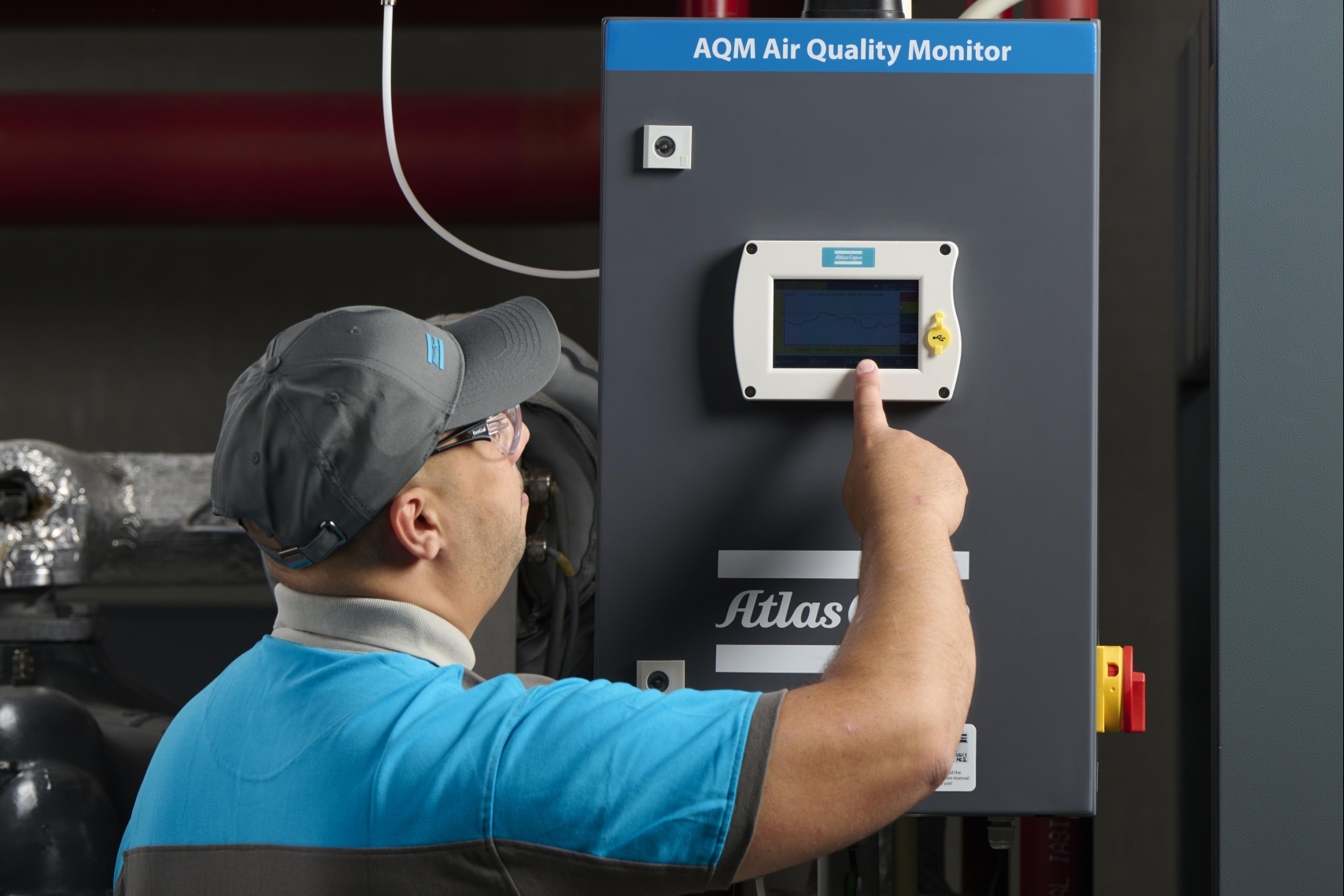
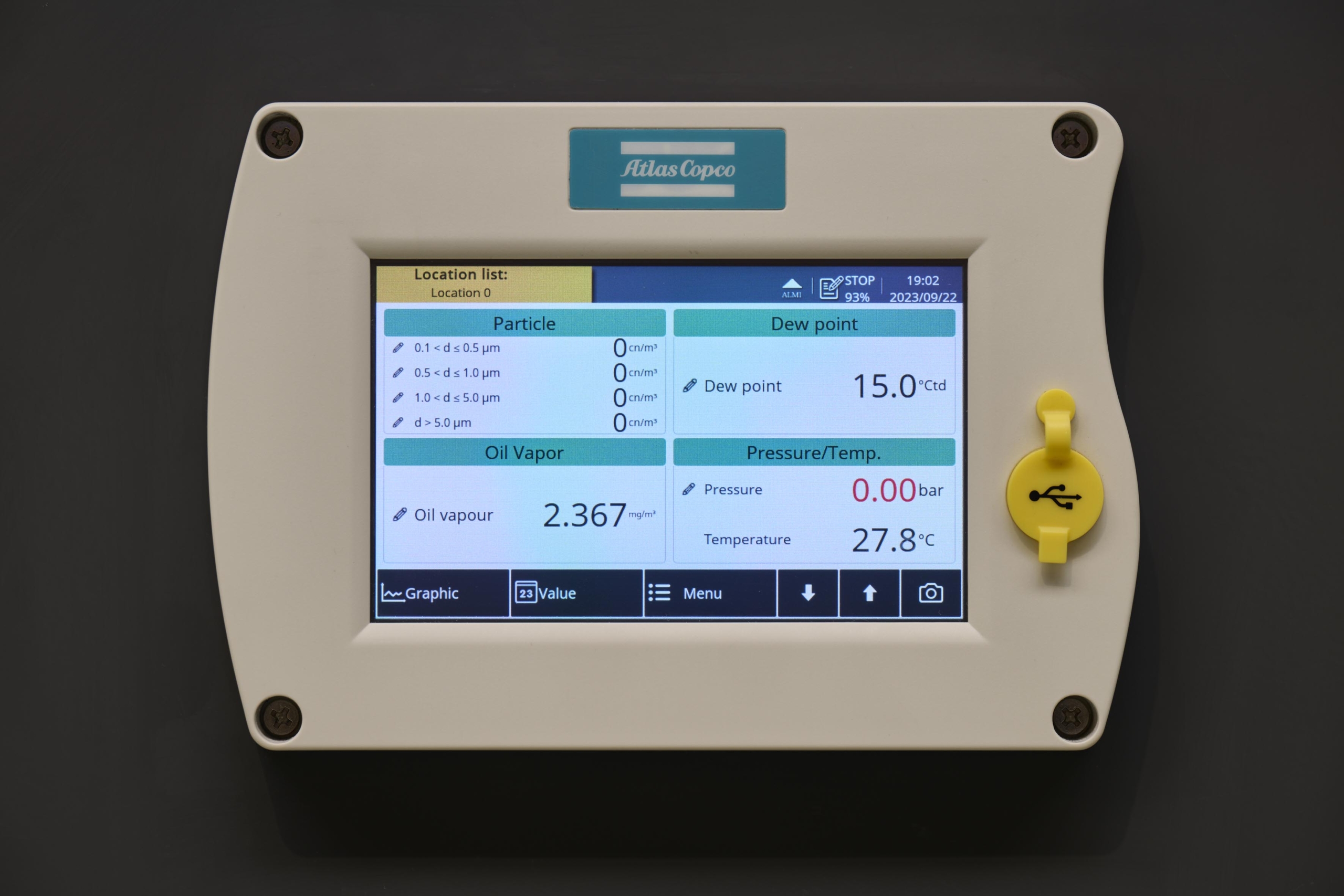
Fixed monitoring systems, by contrast, provide real-time data on dew point, particle concentration, oil content, pressure and flow. This enables early intervention, often before any impact on product or equipment. For food manufacturers operating under ISO 8573-1 requirements or customer-specific quality frameworks, continuous monitoring also simplifies audit readiness. Data becomes a documented trace of compliance rather than something reconstructed after the fact.
This becomes particularly important where compressed air comes into direct contact with food surfaces or packaging. In these applications, the air is effectively treated as a food-contact material. Supermarkets and large retailers increasingly expect evidence – not just assurances – that contamination risks are controlled. Monitoring transforms air quality from an assumption into a measurable value.
Better air, better efficiency
While food safety is the primary motivator, the operational benefits of monitoring are equally compelling. Clean compressed air supports higher overall equipment effectiveness (OEE). Dry, contaminant-free lines minimise unplanned stoppages, and helps prevent premature wear on valves and actuators. Energy efficiency also improves. Blocked filters and moisture-laden air increase pressure drop, causing compressors to work harder and consume more power; often without operators noticing the gradual rise in energy use.
For many food manufacturers, the challenge is integrating air quality monitoring into existing quality-management systems. A practical approach begins with an air quality audit to establish baseline conditions, determine the correct air purity class, and identify potential risks. From there, sites can adopt a mix of technologies: scheduled spot testing for low-risk areas, fixed continuous monitoring where air directly contacts product, and regular data reviews tied to planned maintenance schedules.
Picture: Atlas Copco
The goal is not to install more equipment for its own sake, but to treat the compressed air system with the same diligence applied to raw ingredients, cleaning regimes or traceability. After all, compressed air touches products, packaging, machinery and operators; often simultaneously.
In recent years, food manufacturers have invested heavily in hygiene, automation and digital quality control. Compressed air quality monitoring is the next logical step, offering a simple principle: what is measured can be trusted. In an environment where one contaminant can halt production or trigger a recall, the clarity provided by monitoring is invaluable. When air quality becomes an integral part of best practice, the entire production process becomes more resilient, more transparent and fundamentally safer.
