
3 min read - 3 Jun, 2026
HyKit expands UK hydrogen push with new manufacturing facility
Clean energy entrepreneur Jo Bamford CBE is accelerating his ambitions for a full UK hydrogen economy with the expansion of HyKit, the infrastructure business developing the storage, refuelling and energy systems needed to replace diesel across a range of industries.
HyKit, a joint venture between Bamford’s HydraB group of companies, construction giant JCB, and investment firm HyCap, has developed a new purpose-built factory in Bicester, Oxfordshire, creating 30 high-skilled jobs.
The HyKit site includes an innovative clean room and advanced manufacturing capability designed to support the production of modular hydrogen technologies for industries ranging from construction and agriculture to logistics, temporary power, industrial operations and transport.
The first innovation to roll off the production line is the MHR-X75 mobile hydrogen refueller, developed with more than 90 per cent of components sourced from UK and European suppliers, reinforcing the company’s commitment to building a domestic hydrogen supply chain.
The fully integrated mobile refuelling system combines hydrogen storage and dispensing within a single transportable unit, enabling operators to rapidly deploy hydrogen infrastructure directly to site without relying on permanent refuelling stations. The system has a hydrogen capacity of 75kg, can support multiple on-site machines or multiple refuels, and delivers refuelling turnaround times of approximately 10 to 15 minutes.
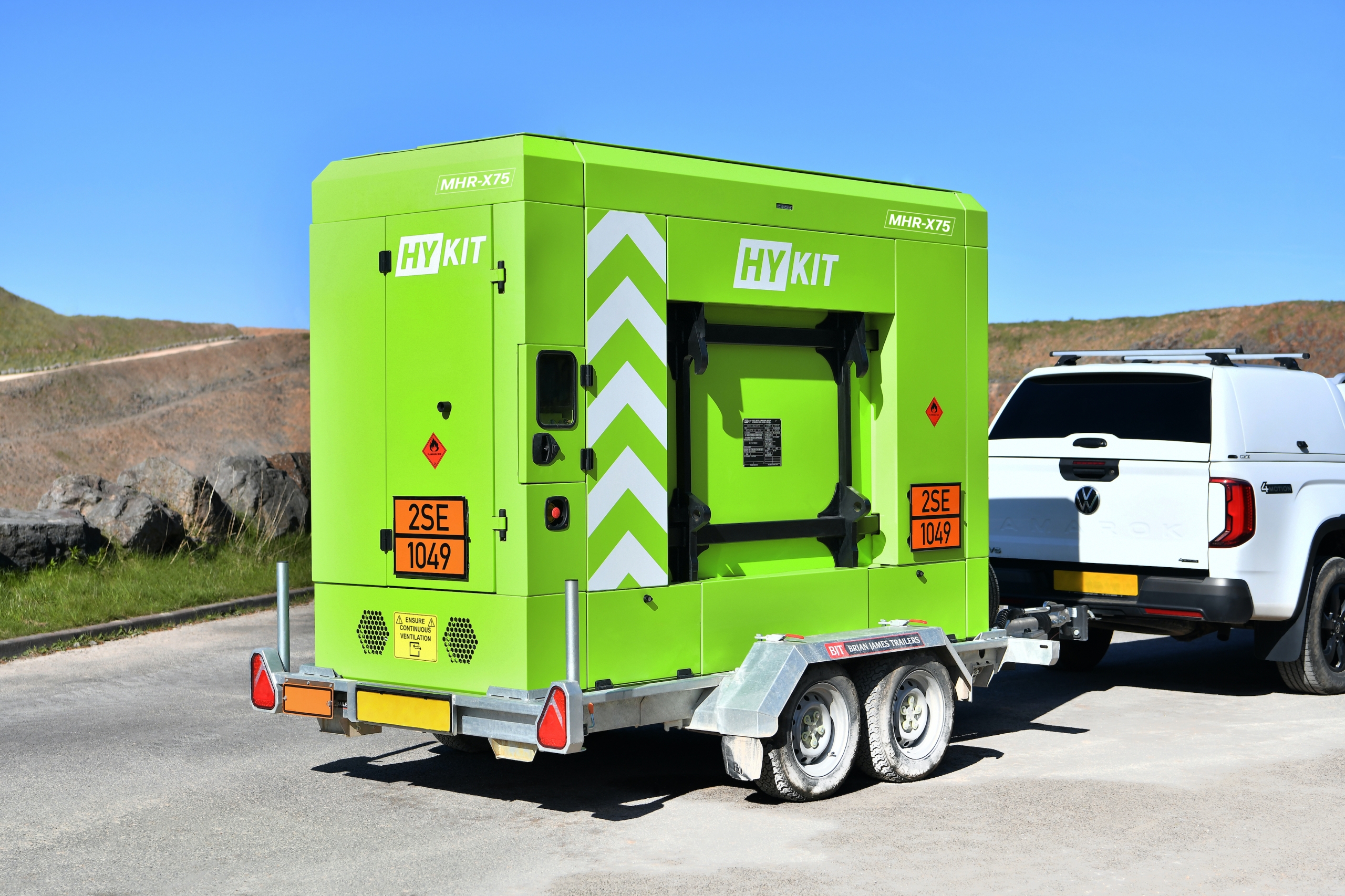
A new purpose-built factory for HyKit in Bicester is accelerating Jo Bamford’s ambitions for a full UK hydrogen economy / Picture: HyKit
The launch comes as demand grows for practical alternatives to diesel in sectors where electrification remains difficult, particularly in heavy industry, off-grid operations and applications requiring continuous high-power usage. Hydrogen is increasingly viewed as a critical solution for decarbonising hard-to-abate sectors, delivering zero emissions at the point of use while maintaining the fast refuelling required for heavy-duty equipment and continuous operations.
Jo Bamford said: “Hydrogen will only succeed if we build the infrastructure to support it. For too long, the conversation has focused purely on vehicles and machinery, but without refuelling, transport, compression and supply systems, adoption simply cannot scale.
“HYKIT is the missing piece of that puzzle. This business is about creating the real-world hydrogen ecosystem needed to decarbonise sectors where battery technology alone cannot deliver the operational performance industry demands. We are building that ecosystem here in Britain, and in doing so, we are creating highly skilled manufacturing jobs, developing UK supply chains and positioning the country to compete in one of the most important industrial transitions of our generation.
“This is much bigger than construction or agriculture. Hydrogen infrastructure has applications across transport, temporary power, logistics, industrial operations, marine and clean energy resilience. The opportunity for the UK is enormous if we move quickly and decisively. Our ambition is simple – to build a complete hydrogen network spanning production, distribution, storage and refuelling that makes clean hydrogen commercially viable at scale.”
Jo Bamford’s HydraB group of companies includes zero-emission bus manufacturer Wrightbus, hydrogen distributor Ryze Power and hydrogen producer Hygen Energy.
